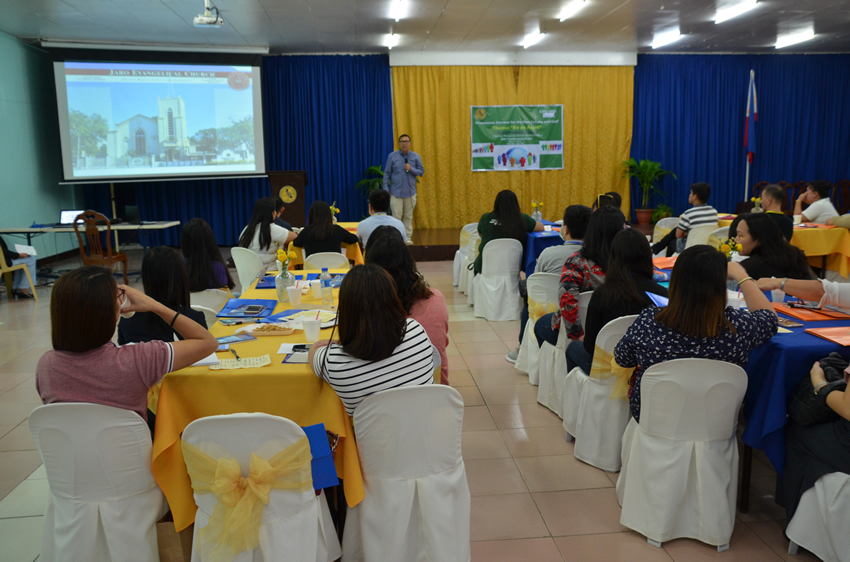
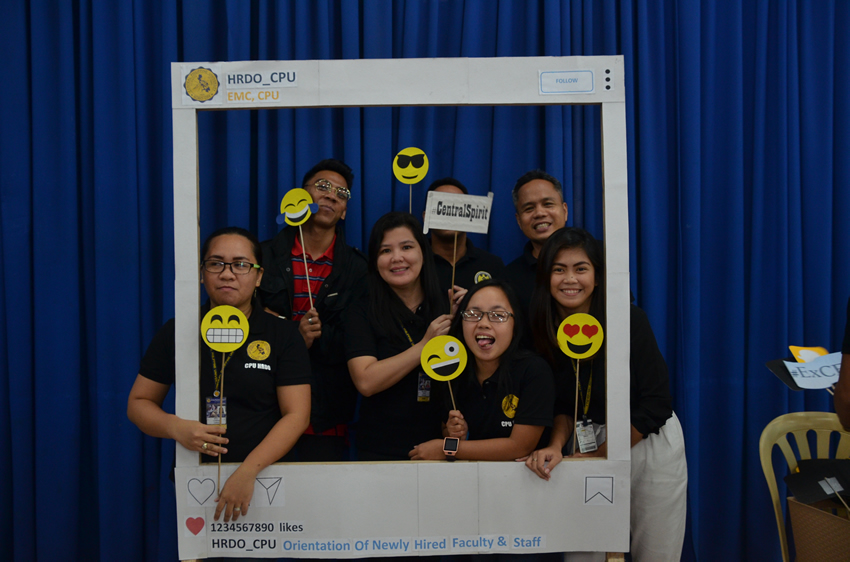
Fifty-two (52) newly hired employees were gathered at the EMC Conference Room on July 27, 2018 and were provided with “important tools” for their jobs. The orientation for CPU’s new faculty and staff started at 7:00 A.M. was facilitated by the Human Resource Development Office (HRDO). This year’s theme is “Be an Asset.”
The registration started at 7:00 AM with HRDO Secretary Myla C. Canlas in charge. The University Church through Ptr. Jho Labis led the Devotional prior to the program. The program proper began with the Opening Remarks by Dr. Florence P. Bogacia, in behalf of University President Dr. Teodoro C. Robles.
The CPU HRDO welcome the new faculty and staff to the CPU family.
The orientation on CPU Culture was handled by Rev. Francis Neil G. Jalando-on, Director, Office of Communications. The Vision/ Mission and Core Values were enumerated and discussed by Rev. Joniel Howard H. Gico, VP for Student Affairs. Dr. Ananias C. Sabijon, Jr., Director, Center for Teaching and Learning Excellence lectured on Commitment and Passion for Excellence in the Work Place.
After lunch, Prof. Rodel C. Palomar, HRDO Director, presented to the participants the Employee Benefits that CPU is providing its employees. The Retirement Policies was explained to the new employees by Ms. Jet Nillos, Acting Retirement Fund Officer.
An open forum followed and team-building workshops followed. Prof. Palomar gave the closing remarks. Lastly, Rev. Chris Amorsolo V. Sian, University Church Senior Pastor, led everyone in the Closing Prayer. Mrs. Johanna Faith M. Candido hosted of the event.
Dr. Mary O’ T. Penetrante, in her closing remarks, highlighted the importance of conducting talks on economic legislations.
In line with the celebration of CPU’s 15th University Research and Development Week, The Knowledge for Development Center (KDC) in coordination with the University Research Center (URC), Human Resource Development Office (HRDO), and Review, Continuing Education and Consultancy Center (RCECC) held a seminar entitled “DevTalk on the TRAIN Law” at the KDC Hall, Henry Luce III Library on March 6, 2018.
The objectives of the seminar included discussing the salient changes to the National Internal Revenue Code of 1997 and other affected laws, determining implications of these changes to educational institutions and individual taxpayers and promoting awareness in price monitoring.
For the welcome remarks, Engr. Amy C. Castigador, Director of the Office of Institutional Advancement, highlighted the partnership of research and taxation in community development. “Recognizing the role of taxation in Research and Development not only for CPU but for the country as a whole, CPU is hosting this DevTalk. We hope that we could have more DevTalks or events that tackle burning development issues with a view to getting some questions answered and identifying actions that may need to be taken. All these we consider as part of our stewardship of God-given resources.”
Atty. Joenifer S. Joslito, Revenue Officer II talked about the benefits of TRAIN Law.Participants composed of CPU faculty, staff and students eagerly listen to the lecture.
Ms. Judith Degala, Consumer Protection Division Chief, Department of Trade I Region VI talked about consumer protection and price monitoring. She also discussed the effects of the TRAIN Law on the price of basic necessities and the role of DTI in regulating the prices in the market.
On the other hand, Atty. Brianna Kay T. De Los Santos, Attorney II, Legal Division; Atty. Joenifer S. Joslito, Revenue Officer II; and Mr. Cecil Rey F. Panelo, Group Supervisor, Revenue Officer IV from the Bureau of Internal Revenue, discussed the effects of the law among private employees. They also tackled the amendments on the NIRC Code and the benefits to be expected in the long term application of the law.
An open forum was then moderated by Engr. Jeriel G. Militar, Chairperson, Mechanical Engineering Department. The questions addressed to the DTI and BIR focused mainly on the effect of TRAIN law to consumer goods and the benefits of its implementation.
For the closing remarks, Dr. Penetrante thanked the resource speakers for sharing their time and expertise and the participants for contributing to the discussion. The closing prayer was led by Rev. Francis Neil G. Jalando-on, Director, CPU Office of Communications.


 seminar